Has your silver jewellery lost its shine? This is perfectly normal. Over time, silver reacts with the air and eventually tarnishes or turns black. But don’t worry, it’s not permanent.
It’s very easy to restore the shine to your favourite silver jewellery. Often, you already have everything you need in your cupboards. There’s no need for expensive products to restore its original shine.
In this guide, find out why silver changes appearance and how to prevent tarnishing in your daily life. Discover our 9 practical and effective tips for cleaning your silver jewellery at home using natural ingredients.
Why does silver jewellery lose its lustre?
Silver jewellery generally tarnishes in reaction to a number of different chemicals, including the elements in the air around us.
This is a natural and unavoidable phenomenon that does not necessarily affect the quality of the jewellery.
At Merci Maman, we attach particular importance to the origin and quality of our raw materials. Our 925 sterling silver, for example, is rigorously selected from responsible suppliers.
We work closely with these suppliers to offer our customers healthy and sustainable products.
What's more, we only use pure materials, which means that all our jewellery is 100% flawless to ensure impeccable quality.
How can you prevent your silver jewellery from tarnishing?
It’s normal for your silver jewellery to tarnish over time, but there are ways to prevent this. Here are our top tips for keeping your silver jewellery looking shiny:
1. Wear your silver jewellery regularly
Wearing your silver jewellery is already an excellent way to prevent it from tarnishing. This is because the natural oils from your skin prevent the silver from losing its shine.
Above all, we recommend wearing it often enough to let the oils keep it looking shiny for you.
2. Remove your silver jewellery if necessary
There are certain situations where it is advisable to remove your silver jewellery to preserve its shine. For example, it is best to avoid :
- contact with chlorinated water ;
- household cleaning products ;
- and direct exposure to sunlight.
Following these guidelines will help you prevent tarnishing and damage that could be fatal to your silver jewellery.
3. Always put on your silver jewellery last as part of your beauty routine
During your beauty routine, you use certain products that can be harmful to silver jewellery. These generally include:
- lotions ;
- cosmetics ;
- haircare products ;
- and perfumes.
These products can cause silver jewellery to tarnish and may sometimes damage it. You should therefore make sure to put them on last to avoid any contact with these products.
The principle is simple. When getting ready, apply your make-up and perfume first, then put on your silver jewellery last.
4. Clean your silver jewellery regularly
Regular cleaning is essential to keep your silver jewellery looking its best. Use a soft cloth designed specifically for silver to polish it gently.
You can also use a silver cleaning solution if your jewellery is very tarnished. We have provided specific instructions to help you avoid damaging it.
5. Store your silver jewellery properly
To prevent your silver jewellery from tarnishing when you are not wearing it, store it in a place that is:
We recommend using anti-tarnish pouches or fabric-lined jewellery boxes to preserve its shine.
Store each piece of jewellery separately to prevent scratches or damage caused by contact with other jewellery.
Cleaning your silver jewellery at home: our 9 practical and effective tips
If your jewellery has already lost its shine, there are a few simple methods you can try at home to clean it. Here are our 9 practical tips to help you clean your jewellery at home :
1. Use a polishing cloth
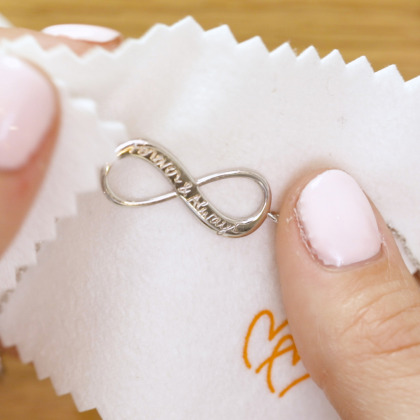
This tip is ideal if the tarnish isn’t too severe. You can easily use a polishing cloth to remove any dirt and tarnish.
To polish your silver jewellery, you can use a jewellery cloth or a microfibre cloth. Then, simply rub it gently.
2. Use soap and water
For this method, add a few drops of washing-up liquid to lukewarm water and mix. Once the solution is ready, soak your silver jewellery in it.
After a few minutes, use a soft brush (for example, a toothbrush) to clean it thoroughly. Make sure you reach all the nooks and crannies.
Finally, dry your jewellery thoroughly and, if possible, avoid using kitchen roll, as this can scratch it. As mentioned above, you can use a jewellery cloth.
3. Use bicarbonate of soda
Bicarbonate of soda is a common household product that you may already have at the back of a cupboard. To clean your silver jewellery, make a paste with bicarbonate of soda and water.
Then, apply a small amount and polish with a cloth. Next, use a soft-bristled toothbrush to clean the nooks and crannies thoroughly before rinsing the jewellery with lukewarm water and drying it with a cloth.
4. Use a jewellery cleaning kit
There are many jewellery cleaning kits available online to help you restore your pieces to their original shine.
Among these, our easy-to-use care kit, available on our website, contains a ‘jewellery shine’ solution in which you can soak your jewellery.
It also includes a small brush and a polishing cloth to remove imperfections and preserve the shine of your precious silver jewellery.
5. Use toothpaste
Toothpaste is another effective home remedy for cleaning tarnished silverware. Use a non-gel toothpaste without whitening agents.
These can be too abrasive for silver. Apply a small amount of toothpaste to a soft-bristled toothbrush and gently scrub your jewellery.
This paste removes tarnish and restores the silver’s shine. After brushing, rinse the jewellery thoroughly under running water and dry it with a soft cloth.
6. Use white vinegar and bicarbonate of soda
For a deep clean, mix white vinegar and bicarbonate of soda. This effervescent mixture helps to dissolve tarnish.
To prepare the mixture, combine half a cup of white vinegar with two tablespoons of bicarbonate of soda.
Soak the silver jewellery in this solution for two to three hours, then rinse and dry it thoroughly. This method is particularly effective for heavily tarnished jewellery.
7. Use ammonia
Although harsher, ammonia can be used to deep-clean heavily tarnished silver jewellery.
Dilute the ammonia with water (approximately one part ammonia to six parts water) and briefly soak your silver jewellery in the solution.
Do not leave your jewellery soaking in the ammonia for too long, as this could damage the silver. Rinse it thoroughly with water after soaking and dry it with a soft cloth.
8. Use aluminium foil and bicarbonate of soda
Another common method for cleaning silver jewellery involves using the chemical reaction between:
- aluminium foil ;
- bicarbonate of soda ;
- and hot water.
To do this, line a bowl with aluminium foil, place your jewellery on top and sprinkle with a layer of bicarbonate of soda.
Then pour hot water over it and leave the jewellery to soak for a few minutes. The chemical reaction will cause it to bubble.
This helps remove tarnish from the silver. Then rinse your jewellery under clean water and dry it with a soft cloth.
9. Use lemon and salt
For a more natural approach, use lemon and salt. Cut a lemon in half, sprinkle a little salt onto the cut surface and rub it directly onto your silver jewellery.
The salt acts as a gentle abrasive and the lemon as a natural acid that helps remove oxidation. After cleaning, rinse your jewellery in lukewarm water and dry it thoroughly.
FAQ: Our answers to frequently asked questions about cleaning silver jewellery
What is the difference between 925 silver and silver-plated metal when it comes to cleaning?
925 silver (or sterling silver) is a solid metal that can be polished indefinitely. Silver-plated metal, on the other hand, is simply a thin layer of silver deposited onto a base metal (brass, copper).
Cleaning silver-plated metal too aggressively risks removing this layer and revealing the metal underneath.
Can I clean silver jewellery set with semi-precious stones using these methods?
Warning: certain porous stones such as pearls, turquoise or opals do not tolerate vinegar, salt or lemon.
For this jewellery, avoid soaking. Use only a soft, damp cloth to clean the metal part without touching the stone.
Why is bleach the sworn enemy of silver?
Bleach causes an instant and severe chemical oxidation reaction.
It can blacken silver almost irreversibly or cause pitting in the metal.
If your jewellery comes into contact with bleach, rinse it immediately with clean water.
Is it risky to clean your jewellery too often?
Frequent polishing, even with a soft cloth, removes a tiny layer of metal.
For daily care, simply rinse with lukewarm water and dry thoroughly.
Reserve more intensive methods (bicarbonate of soda, vinegar) for occasional use.
Why does my silver jewellery tarnish more quickly in summer?
Sweat is acidic and contains sulphur, which accelerates oxidation. Furthermore, ambient humidity and more frequent exposure to sun cream during the summer months encourage tarnishing.
Can my skin’s pH affect the shine of my jewellery?
Absolutely. Everyone has a different skin pH. Very acidic skin will cause silver to tarnish much more quickly.
This is why the same piece of jewellery can remain shiny on one person and tarnish within two days on another.
Can an ultrasonic cleaner be used for silverware?
Yes, ultrasonic cleaners are very effective at removing dirt from the nooks and crannies of engraved jewellery.
However, they do not always remove chemical oxidation (the black tarnish) and must never be used on jewellery with glued or fragile stones.
Is it true that putting a piece of chalk in your jewellery box helps prevent tarnishing?
It’s an excellent tip! Chalk absorbs moisture from the air and sulphurous gases present in the atmosphere.
Placing a piece of chalk in your jewellery box naturally slows down the oxidation process of your silver pieces.
How can you tell the difference between accumulated dirt and genuine oxidation?
Dirt (dust, sebum, cosmetics) makes the jewellery feel ‘dull’ or greasy to the touch. Oxidation, on the other hand, changes the colour of the metal to yellow, brown or black.
Dirt can be removed with soapy water, whereas oxidation requires a chemical reaction or polishing.
Conclusion
Voila! We hope you find these tips on how to clean your jewellery at home helpful. Let us know if you try any of these methods and show us your new, sparkly jewellery over on our social media.